Monday, December 28, 2009

Philadelphia Brigade Park


The Philadelphia Brigade Park is stop number 5 on the auto tour of the field. It is marked by a stone obelisk rising 73 feet above the surrounding 11 acre park. A recent study by Susan W. Trail titled, Remembering Antietam: Commemoration and Preservation of a Civil War Battlefield [1] describes the creation of Antietam National Battlefield. In it she describes how the Philadelphia Brigade Park came to be.

During the 1890s, national parks were established to commemorate the conflicts at Gettysburg, Shiloh, Chickamauga/Chattanooga, Vicksburg, and Antietam. Soon states and veterans organizations began erecting regimental, brigade, and state monuments along the roads and fields of these parks. At Antietam, the Philadelphia Brigade Association sought a suitable location to erect memorials to the four brigades--the 69th, 71st, 72nd, and 106th Pennsylvania--who fought under Oliver O. Howard and who were collectively known as the Philadelphia Brigade.

In the early spring of 1895, the Association contacted Antietam Battlefield Board President Major George B. Davis about creating monuments to each of the brigades' four regiments. Davis, in reply, expressed his "dislike of 'tombstones' across the battlefield, recommending instead that it erect one monument to the entire Brigade." p. 250.

The Association, adopting Davis' suggestion, then met with Ezra Carman in mid-August to select the monument's location. The property the Association wanted was owned by George H. Poffenberger, a farmer with a cantankerous reputation and a keen eye for profit. "The members had intended on buying a small lot just large enough to hold the monument, but when Poffenberger offered to sell them 1/4 acre for the exorbitant price of $400, or eleven acres for $1,000, they quickly chose the latter after consultation with Gen. Carman." p. 250.

With an agreement in hand, the Association began raising funds to purchase the land, make improvements, and build a suitable monument to the brigade. Of the contributors, the Pennsylvania State Legislature gave $5,000--a generous sum but less than what they would have given for four individual brigade monuments--which were allocated by the state at $1,500 each.

On September 17, 1896, the Association joined by governors from Pennsylvania and Maryland and "a substantial number of veteran's organizations" gathered to dedicate the park. p. 251.

While the Association had intended to turn its new park over to the War Department, this action was delayed. One possible reason was a "dispute arising over surplus cannon balls that the Secretary of War had agreed to provide the Association to embellish the grounds of the park. Evidently, the Association believed that this agreement included the cannon carriages, and did not find out otherwise until less than two weeks before the dedication. The controversy continued for another year, until the Secretary of War finally rescinded his original agreement." p. 251, note 22.

Left with the responsibilities of administering the park, the Association turned to the City of Philadelphia who took over the park in 1903. George H. Poffenberger was hired as caretaker--something he neglected and his employers regretted. As complaints about the condition of the Park rose, a military investigation found "a locked gate [to the park entrance], 'many benches scattered about, helter skelter, and an unsightly wire fence strung within the ornamental iron fence to keep in sheep that the caretaker is reported to pasture there to save the use of lawn mower." p. 311.

The Hagerstown Chamber of Commerce then got involved. Led by John B. Ferguson, the Chamber contacted the City of Philadelphia in May 1932 to propose that the city open the park to the public, dismantle the troublesome gate under the control of Poffenberger, and turn the maintenance of the park over to the War Department which was doing a good job with other parts of the field. The title to the park would be transfered to the War Department as well. After a number of false starts, the park came into the National Park Service hands in September 1940. p. 360.

The Third Delaware monument in the field due north of the Philadelphia obelisk in 1964 marked the final addition to the Philadelphia Brigade Park .

Today parts of the original fencing can still be seen marking the the 11 acre original purchase. The property to the south all the way to the Dunkard Church and to the west to the by-pass are now in NPS hands and a master plan for the West Woods (and the original Philadelphia Brigade Park) envisions a careful restoration of field and buildings to September 17, 1862.

Notes:

[1] All page references are to: Susan W. Trail, Remembering Antietam: Commemoration and Preservation of a Civil War Battlefield. Dissertation, University of Maryland, College Park, 2005.

All photographs in black and white or sepia from the Antietam National Battlefield Library, courtesy of NPS Ranger Allan Schmidt.

Photo 1. The Philadelphia Brigade Park, ca. 1935. The two small signs to the right and left of the roadway read: (left sign) "Battlefield Visitors May Lunch Here 9 AM Till Dusk, No Entrance After Dusk"; (right sign) "Keep Motor Cars Off The Grass, Park 45o on Driveway."
Photo 2. The troublesome gate, ca. 1926.
Photo 3. Looking north to the Philadelphia Brigade Monument from the Dunker church, ca. 1950s. The George H. Poffenberger farmstead is in the far left of the frame.
Photo 4. The same shooting location as Photo 3 but a few years later. Looking north to the Brigade Monument from the Dunkard Church, ca. 1960.
Photo 5. Workers setting cement fence posts along the southern boundary of the original 11 acre Philadelphia Brigade Park, ca. 1930s.
Photo 6. Cement fence posts and rusted fence wire still mark the boundary of the original Brigade Park. Debris from the George H. Poffenberger farmstead still litter the newly-acquired property.

Thursday, December 17, 2009

"As grain before the scythe:" The Nineteenth Massachusetts in the West Woods

On September 17, the 19th Massachusetts found itself "hotly engaged" in the West Woods where they would lose half the regiment. In the midst of this stood John G.W. Adams (1) a shoemaker from Groveland, Essex County, Massachusetts. Years later Adams would publish a history of the 19th and in it would record the loss of one brother and the reunion of another. (2)

"We arrived at South Mountain while the battle was being fought, but took no part in it. The 16th of September we reached Antietam, and formed in line of battle. On the morning of the 17th, with our brigade in the centre, we advanced in three lines of battle, over walls and fences, through fields, under a terrible fire of artillery. (3) The regiment was growing nervous but did not break. Colonel Hincks (4) halted us, put us through the manual of arms, ending with parade rest. Having become steady, we moved forward to a strip of woods, and came upon the enemy strongly posted. Grape and canister, shot and shell, volleys of musketry greeted us, - and our men fell as grain before the scythe.

One-half of our officers and men were either killed or wounded. Colonel Hincks was the first to fall, again terribly wounded. Capt. George W. Batchelder (5) was killed, and the command of the regiment and companies changed fast, as one after another officer went down. At the time we were so hotly engaged in the front we began to receive a fire from our left and rear, and discovered that we were being flanked, and must change front to rear. This was done by the 19th Massachusetts and 1st Minnesota. We were now under command of Colonel Devereaux,(6) and were ordered to take a position near a stone wall. We fired as we fell back, holding the enemy until we had reformed our lines, when we again went in and continued fighting until dark, when we were ordered to support a battery. We then had time to count the cost of the battle. Colonel Hincks was reported dying, and we mourned the loss of our brave leader.(7) Captain Batchelder was dead. He had been my tent-mate since I had been an officer, and had rendered me valuable assistance. Every one loved him; he was an ideal volunteer soldier. Having graduated at Harvard, he entered the army as an enlisted man in the Salem Zouaves at the first call for men, and had worked hard to bring the regiment to the state of efficiency which it had reached.

I had not seen my brother (8) since we had advanced in line. He was left general guide of the regiment, and his place was on the left. As soon as we halted I went to the company, but he was not there. The following day I searched the hospitals, but could not find him, and on the morning of the 19th, the rebels having left our front, I went where their lines had been and found him, with Jacob Hazen of Company C and George Carleton of Company B, near an old haystack. He had been shot in the right side of the neck, the ball passing out of the left shoulder; it had cut the spinal nerve, and he could not move hand or foot. I saw at once that he could not live and had him placed in an ambulance and carried to our field hospital. It was the saddest duty of my life. We had left home together, and had often talked of a happy reunion around the old fireside when the war should end. Now I must write to my old mother that one of the three who had bade her good-by in '61 would never return.

This was war, terrible war! As I was kneeling by his side, hearing his last words, a woman's voice said, "Is he your brother?" I explained to her the fact that I was in command of my company and could not stay with him, but could not bear to have him die alone. With tears streaming down her motherly face she promised me she would not leave him, but would see him buried and would send me word where he was laid, - which promise she faithfully kept. The name of this good woman was Mrs. Mary Lee of Philadelphia, Pa.(9) She had a son in Baxter's Fire Zouaves,(10) who was with her that day. Several years ago, when Post 2, G.A.R., of Philadelphia, was in Boston, I saw that one of the old battle-flags was the Fire Zouaves, and was carried by Sergeant Lee.(11) He proved to be the son I had met that sad day at Antietam; a few months later I visited his mother in Philadelphia, who was working just the same for the soldiers as she had done during the war.

While my brother lay wounded on the field inside the rebel lines an officer of the 8th South Carolina came along, and seeing 19 on his cap asked to what regiment he belonged. Being informed that it was the 19th Massachusetts, he said he had a brother in that regiment named Daniel W. Spofford. My brother told him that his brother was wounded in the battle, and might be on the field. He searched for him but did not find him, as he was able to go to the rear before we changed front. Returning, he had my brother carried to the haystack where I found him, and rendered all the assistance possible. The name of the South Carolina officer was Phineas Spofford. Both brothers survived the war. The Union soldier resides in Georgetown, Mass., the rebel in South Carolina, but he often visits his native State.(12)

I also missed my boy Patch.(13) He was last seen helping a sergeant from the field. He turned up in Libby Prison a few days later. My old company had met with other losses than death. Four men had deserted on the eve of battle. They had taken the canteens of the company to go in search of water. No doubt they are searching yet, as they did not return. Two were non-commissioned officers, and all were intelligent men."

Notes:

1. The 1860 Federal Census lists John Adams (age 18) and his brother Isaac (age 27) at home in Groveland, Essex County, Massachusetts. Both listed their occupations as shoemakers. They resided with their parents Isaac and Margaret. The 1850 Federal Census lists an older brother Asa F. Adams, then 23, who would have been about 35 in 1862.

2. John G.B. Adams, Reminiscences of the Nineteenth Massachusetts Regiment, (Boston: Wright, Potter Printing Company, 1899). This account was transcribed by Kerry Webb from a copy of Capt. Adams' book held in the National Library of Australia. The transcription can be retrieved at http://sunsite.utk.edu/civil-war/Mass19.html.

3. "The Nineteenth Regiment was on the extreme right of the second line of battle, the Minnesota regiment being on the right of the first line, when the Minnesota was the last regiment in its line to leave the position, and was immediately followed by the Nineteenth." Official Report by Captain Harrison Gray Otis Weymouth, Bolivar, Virginia, September 29, 1862. 4. Col. Edward Winslow Hinks or Hincks. 5. George W. Batchelder was a 23 year old lawyer from Salem, Massachusetts. Commissioned 1st Lt. August 1861 and commissioned Captain March 1862. 6. Lt. Col. Arthur Forrester Devereux (1838-1906). 7. Col. Hinks (Hincks) survived his wounds. "In November 1862 he was appointed Brigadier General of Volunteers, and served on court martial and recruiting duty, was a prison camp commander, and commanded the 3rd Division/XVIII Corps (US Colored Troops) at Petersburg. He then had draft and recruitment duties. Continuing in US Army service he was Lt. Colonel of the 40th US Infantry in 1866, transferred to the 25th Infantry in March 1869, and retired at the rank of Colonel in December 1870. He died on February 4, 1894 in Cambridge, Massachusetts. " Retrieved from Brian Downey's definitive Antietam website: Antietam on the Web at http://aotw.org/officers.php?officer_id=268&from=results . 8. Isaac Adams.

9. Mary Lee was one of the leading organizers of the Union Volunteer Refreshment Saloon founded on May 26, 1861. Frank H. Taylor, Philadelphia in the Civil War, 1861-1865 (Philadelphia: Published by the City, 1913), p. 207. See further, Marjorie Barstow Greenbie, Lincoln's Daughters of Mercy (New York: G.B. Putnam's Sons, 1944).

10. The 72nd Pennsylvania Volunteer Infantry Regiment was organized in Philadelphia.

11. Probably William H. Lee, Company A, 72nd Pennsylvania. History of Pennsylvania Volunteers, 1861-5; prepared in compliance with acts of the legislature, by Samuel P. Bates. Author: Bates, Samuel P. (Samuel Penniman), 1827-1902.

12. Aaron and Betsy Spofford sent three of their sons to war from Boxford. Daniel W. Spofford (b. 11.30.34) enlisted in Company A of the 19th Massachusetts on August 9, 1861 and was mustered in two days later for a duration of three years. His wound put him in the hospital where he remained until October 12, when he again joined his regiment. His brother, Aaron (b. 4.20.33), had enlisted in Company E of the 12th Massachusetts on June 11 and was mustered in June 26 for three years. Aaron was killed at the Second Battle of Bull Run on August 30, 1862. Their older brother was Phineas F. Spofford. Sidney Perley, History of Boxford, Essex County, Massachusetts, From the Earliest Settlement Known to the Present Time: A Period of about Two Hundred and Thirty Years (Boxford, MA: Published by the Author, 1880), p. 324.

Phineas F. Spofford was captain of Company D of the 8th S.C. He survived the war and in 1870 was living in Cheraw, South Carolina. He left the family home sometime before 1850 since that year's census shows him living and working in neighboring Georgetown. He was 22 and was listed as a shoemaker. He was living in company housing provided by a shoe factory probably owned by Luther D. Perley, listed in Census as "shoe manufacturer." The Spofford and Perley families were related by marriage at the turn of the century and there may have been some sort of familial arrangement that brought Phineas into the Perley shoe manufacturing business in Georgetown. What brought Phineas to South Carolina and into the 8th South Carolina remains a mystery. By 1860 he had established residence in the large household of South Carolina native R.L. Edgeworth in Chesterfield, South Carolina. One of Phineas' housemates was J.W. Kibbin, a shoemaker from Massachusetts. He remained in South Carolina after the war--the 1870 Census shows him living in Cheraw--and ten years later he had moved back to Chesterfield where he assumed duties as the town sheriff, was a bachelor, and "resided" with five men listed as prisoners. Perley, ibid., p. 324; Memoirs of Robert E. Lee, eds. Armistead Lindsay Long, Marcus Joseph Wright, (New York: J.M. Stoddart, 1886), p. 664; (http://www.aciglobal.com/claunch/1870ches.html); D. Augustus Dickert, History of Kershaw's Brigade (Project Guttenberg eBook, release date August 6, 2004 [eBook #13124]; 1850 Federal Census for Massachusetts; History and Genealogy of the Perley Family, M.V.B Perley, compiler (Salem, MA., self published, 1906), p. 80 and retrieved at http://www.archive.org/stream/historyandgenea00perlgoog/historyandgenea00perlgoog_djvu.txt; 1870 and 1880 Federal Census for South Carolina.

13. George H. Patch (1844-1887), Company I, 19th Massachusetts. Patch survived the war and settled in Framingham, Massachusetts. Adams, op. cit.; Historical Data Systems, comp.. U.S. Civil War Soldier Records and Profiles [database on-line]. Provo, UT, USA: Ancestry.com Operations Inc, 2009; 1880 U.S. Census for Massachusetts.

Images:

First: Detail from Carman/Cope map, Library of Congress.

Second: Life Magazine Collection, Google Images.

Sunday, December 6, 2009

Illumination--December 5, 2009


Every year for the past two decades or more the first Saturday of December marks the illumination of the battlefield. On that day (and the night before) thousands of volunteers place more than 23,000 candles on the field, each representing a casualty of September 17, 1862. The candles, which can burn for five hours, are encased in paper bags which are weighed down by a cup or so of sand. The effect, once lit, is unforgettable. The visual display of 23,000 casualties laid out from the Joseph Poffenberger farm on the northern edge of the field to the Burnside Bridge and beyond to the south is hard to describe. Just when you think you have seen all that a field of candles can offer, you crest a rise and before you lies other fields stretching on into the night each bearing their illuminations--their memories--of lives changed on this field those many years ago.

This year an early Nor'easter roared up the Atlantic coast. These storms, originating in the Gulf of Mexico, are snow machines. Their counterclockwise rotation wicks moisture from the warmer Atlantic and dumps it over the cold continental air mass--a conveyor belt of moisture turning to snow propelled by stiff winds.

The combination of the heavy wet snow that fell and the winds conspired to test the best plans of the volunteers (and the National Park Service). All day, the volunteers struggled with their task. The snow, melted around the warm lit paper bags, collapsed them onto the candles which either extinguished the flame or sent everything up in one conflagration. By late afternoon, nearly all bags were soaked and the prospect of an illumination dimmed.

Instead of despair, the volunteers felt that they had done what they came for--to honor the memories of those whose lives forever changed that day. One Boy Scout, who had been working on the field for the better part of 8 hours said that he now had some appreciation of what the winter at Valley Forge might have been like. Others were satisfied that they had done their part and had done it well. For all on the field, NPS Rangers, volunteers, and others December 5, 2009 will be recorded in the oral history of the illumination for generations to come--"Remember that snowstorm? That wind wouldn't let up. I wonder if anyone found my lost glove? What're you going to do? It's Mother Nature."

====
Picture captions from top to bottom:

1. Looking north into the teeth of the storm from S.D. Lee's position on Antietam Ridge. The carefully laid rows of candles recede into the distance toward the Maryland Monument.
2. Looking west, a group of volunteers tending a candle in the far distance. The 20th New York Monument and the Visitor's Center stand to the right.
3. A volunteer, one of thousands who traveled from all over the country to create the illumination. The near-horizontal snow blowing southward.
4. NPS Rangers--the best--out since morning manning the traffic check points and still maintaining a sense of humor.
5. One of the few candles that defied the elements--at least for awhile. The bag sagging from the snow collapsed a few minutes later extinguishing the flame but not the memory.

Friday, November 27, 2009

Dunkard Church Rising

On September 17, 1906, Thomas J. Stewart, Adjutant General of Pennsylvania, addressed those gathered for the dedication ceremonies for the Pennsylvania Reserves monuments at the Antietam Battlefield.

"It is a glorious thing to be here," he told the crowd, "As long as this nation lasts the story of Antietam will be told and when these monuments have crumbled to dust, Antietam's story will live in the greatness of your example and in the glorious deeds done on this field. As long as the wind shall blow across yonder sunken road, they will sing the requiem for the mighty dead of this field; as long as the walls of the Dunkard Church shall stand they will seem to tell the story of the awful carnage of that place. …" (1)
Less than fifteen years later the walls of the Dunkard Church no longer stood.

After the battle, the damaged church was restored and rededicated the following year. Services were resumed in it in 1864. Around 1916 the Dunkards moved to a new church location in Sharpsburg and the battlefield church was abandoned.

Over the next five years, neglect and souvenir hunters--who chipped away at the brick--left the church walls weakened.

A heavy storm on May 23, 1921, caused the walls and roof to collapse. (3)

The furniture and some building materials including bricks were salvaged by Elmer Boyer.(4)

The church site was developed into a lunch room known as “Poffenberger’s Lunch Room.”

Eventually Boyer sold the original bricks and other building material to the National Park Service in 1951. A restoration project was finally completed in 1962 through a cooperative effort between the National Park Service, the Washington County Historical Society, the State of Maryland, and the Church of the Brethren. (3)

While the church was restored, its surroundings remained in private hands. The final photo in this series shows the Dunkard Church in 1971.

1) Albert L. Magilton, "Report of the Antietam Battlefield Memorial Commission of Pennsylvania Ceremonies: Dedication of the Monuments Erected by the Commonwealth of Pennsylvania Mark the Position Of Four Regiments Of The Pennsylvania Reserves Engaged In the Battle. (Harrisburg, Pa.: Harrisburg Publishing Company, State Printer, 1908). Retrieved from:

http://www.archive.org/stream/secondbrigadeofp00penn/secondbrigadeofp00penn_djvu.txt


2) "The Angle" Gettysburg Civil War Roundtable Newsletter, May/June 2009, page 3.


3) Freeman Ankrum, from Sidelights on Brethren History, (Elgin, IL: The Brethren Press, 1962), pp. 99-108. Retrieved from http://www.rockhay.org/peace/dunkerchurch/index.htm


(4) Elmer G. Boyer ran a grocery in Sharpsburg, Maryland. He resided at 142 Chapline Street with his wife and two children. (US Census, 1930).


Photos from Antietam National Battlefield Archives and Library. Courtesy NPS Ranger Alann Schmidt.

Wednesday, November 25, 2009

Howard's Left (Part 2)

Over the summer I posted a note regarding the location of the left of Howard's Philadelphia Brigade in the West Woods. All accounts show that the 72nd Pennsylvania (Baxter's Fire Zouaves) took up the extreme left of the brigade; the exact position of the regiment, and Howard's left was the mystery. Some maps show them within the confines of the 11 acre Philadelphia Brigade park; others, including the Cope/Carmen map, show them much further south at the Dunker Church.

Don Gallagher, Historian of the 28th Pennsylvania Historical Association (http://www.28thpvi.org/) forwarded an article that supports the view that the 72nd operated near the Dunker Church. The article, written by James F. Larkin, Company K of the 72nd Pennsylvania, was published in the Philadelphia Weekly Times in 1882.

Don wrote: "[Larkin] mentions seeing the 28th PA as they were advancing out of the Cornfield and towards the West Woods. A large number of the men in the 28th were from Philadelphia and the whole regiment was organized and trained in the city. Several companies of the 28th were recruited from the same neighborhoods as 72nd and it's likely there were acquaintances. At the time I believe the 28th was just south of the Smoketown Road probably near or possibly South West of the Mumma Cemetery. This would place the 72nd pretty far to the left on Howard's line. "

Below is an excerpt from the article that Don forwarded and is posted here with permission. To the left is the Cope/Carmen map of the West Woods action between 9 and 9:30. This along with the Larkin account suggests that the left of Howard's brigade rested very close to the Dunker Church.

Larkin writes: "...On arriving at the Antietam creek, which was waist deep, we were compelled to ford it, holding our guns and ammunition up over our heads.

During our advance we passed through an apple orchard, the trees of which were fairly bending to the ground with their loads of ripe, luscious fruit, and the men actually under fire, with shot and shell screaming and tearing around and among them, their line dressed as if on parade, with arms at “right shoulder shift” went on at a “quick step,” eating apples. We had now reached the famous cornfield, and death and destruction were seen on every side of us.

We emerged from the cornfield into a freshly ploughed field. Here we passed Geary’s Twenty-eighth Pennsylvania Regiment lying as support or reserve, who gave us three hearty cheers as we passed on, and above the din and roar of battle we distinctly heard them give “three more for Philadelphia,” You cannot conceive with what wild joy and excitement the mention of our dear home at such a time created. It electrified the men, and the answering shout that went up from us was enthusiastic beyond description. Our advance was still beautiful, the alignment perfect, but still the cautionary command of the file closers of “steady men,” “guide on the colors,” was at short intervals heard.

We had now arrived within two hundred feet of a piece of thick woods, where the enemy’s artillery had been planted early in the morning and the hundreds of dead and wounded that strewed the ground in every direction, mutely attested with what terrible vigor and execution those guns had been served. Suddenly, loud above the rattle of musketry and the roar of the artillery, that historic rebel yell was heard. To those who have never heard it I will simply say that it is indescribable; but if ten thousand fiends were unchained and let loose it could not be more unearthly.

We rightly surmised that this yell boded no good to the Union troops, for immediately from the wood in front came pouring in the utmost disorder and confusion our whole front line in wild retreat. What caused this break is a mystery, as no better or braver troops than Sedgwick’s Division of Sumner’s Corps (the Second) ever shouldered gun or drew sword in defense of the Union. The command to fix bayonets was promptly obeyed, the object being to endeavor to prevent the breaking of our line, but in vain, for such was the rush and crush that it was beyond human power to stop the frantic retreat of the fugitives.

Our splendid line, before this mad rout, was broken badly and almost rendered useless for effective work; but the color guard with the colors still stood firm with four or five companies intact, and the remnant of the other companies, which had been shattered, quickly rallied on this point.

We were all this time exposed to a galling, murderous fire in front left flank and rear, and the casualties were terrible. Human flesh and blood could not stand that iron storm longer, and the command was given to “fall back.” The writer of this was wounded within thirty yards of the piece of woods where we first saw our front lines fleeing and lay on the field until late in the afternoon, and can, therefore, truthfully bear witness that the Seventy-second Pennsylvania was the “last to go” from that part of the field of Antietam, and for the information of our Massachusetts friend (1) I would state that the troops which we recognized as breaking through our line was the Thirty-fourth New York Volunteers and that they were either a portion of Gorman’s or Dana’s Brigade- he probably knows which. Who were “the first to go” I am unable to say; but this I do know, that after they did go, and were no longer to be seen, the Seventy-second Pennsylvania lost more than one-half it’s effective force."

Many thanks to Don Gallagher for his invaluable contribution to this post.

=========
Note:
(1) A reference to Frances Winthrop Palfrey's criticism of the 72nd's action in the West Woods in his book published in 1882 titled The Antietam and Fredericksburg. Palfrey wrote: "The third line, the Philadelphia brigade, so called, was the first to go. Sumner tried to face it about preparatory to a change of front, but, under the fire from its left, it moved off in a body to the right in spite of all efforts to restrain it." Larkin titled his article "The Last To Go: A Description of the Charge by a Private in the Seventy-Second Regiment."

Sunday, November 15, 2009

Sunday, November 15, 2009

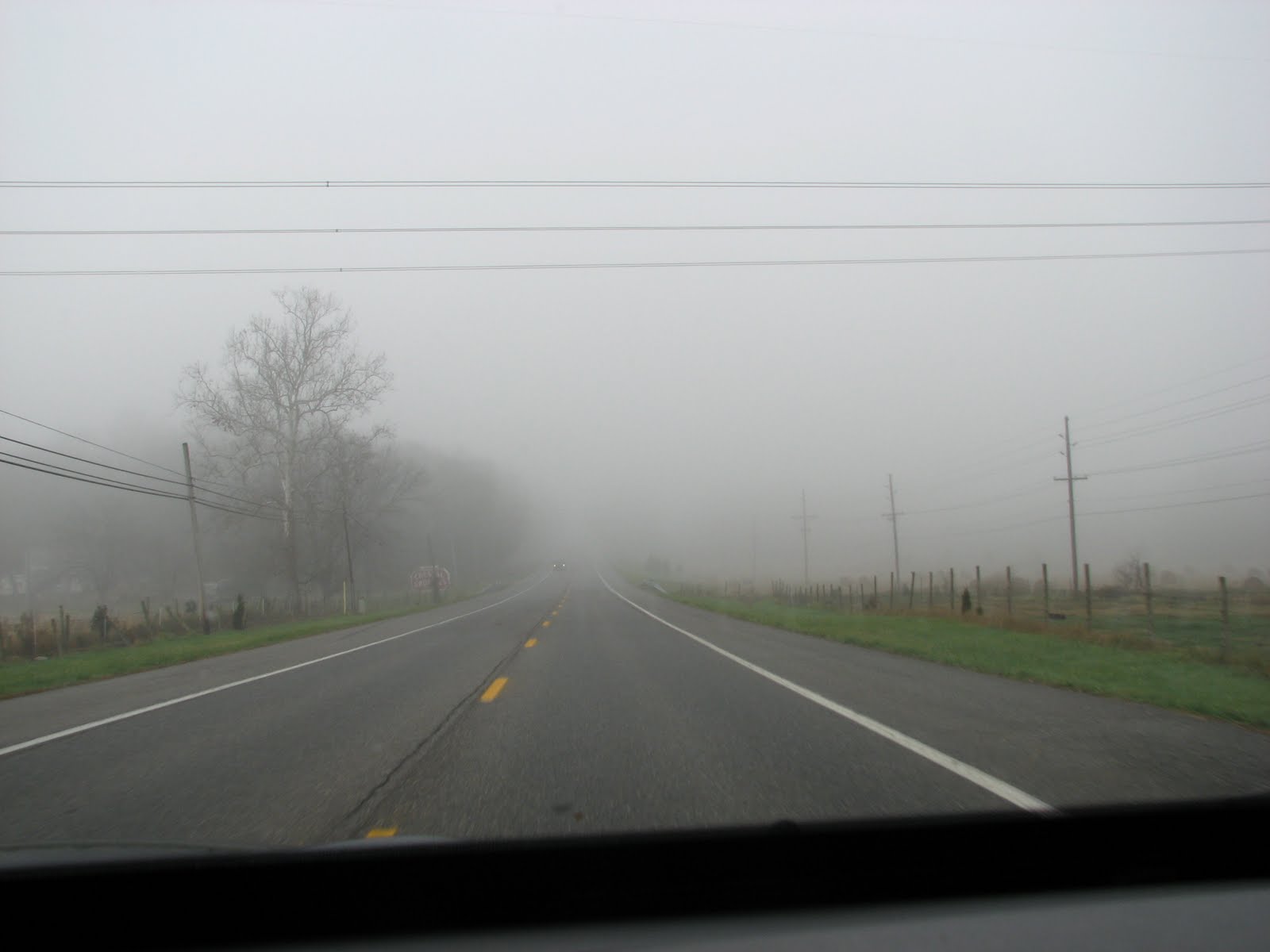
My route to the field takes me on U.S. Route 40 (Alt) west through Middletown, across Turner Gap, and then into Boonsboro.

This morning dawned clear and bright and dry--at least on the east side of the South Mountain.

As I came through Middletown, I noticed in the distance what appeared to be smoke--a lot of it.

It didn't take too much longer to realize that the smoke was heavy fog pushing its way out of the Pleasant and Antietam Valleys to the west of the mountain.

The photo at left is taken just west of Middletown looking west along U.S. 40 toward South Mountain.

The "smoke" is rolling off the mountain side.


The valleys to the west of South Mountain have their own microclimates, or so it seems. Clear on one side and fog on the other; snow on one side and rain on the other, and so on.


Crossing Turner's Gap, I went from bright sun to fog which grew denser with each mile.


The fog this morning brought to mind the conditions on the morning of the 16th September 1862--fog so thick that the west side of Antietam Creek was all but invisible to those on the east.

On the 17th "daylight was slow in coming. The rain had stopped but it had left a heavy overcast, a foggy mist that covered the fields." {1} Soon the fog would drift revealing to all the work before them.

Note: 1. James V. Murfin, The Gleam of Bayonets, (Baton Rouge, LSU Press, 2004 edition), p. 211.